Conversely, outfitting a kitchen server station with an intricate, accessory-heavy cocktail well is a massive waste of capital.
Understanding the functional, mechanical, and operational differences between a restaurant-focused ice box and a bar-specific ice well is crucial for optimizing your venue's workflow. Let’s break down exactly how these two categories differ and how to choose the right one for your business.
1. Operational Intent and Placement
The primary divider between these two units is where they sit and who uses them.
| 1. Commercial Restaurant Ice Bins | 2. Professional Bar Ice Bins / Wells |
|---|---|
| Primary Location: Back-of-house (BOH) kitchens, prep corridors, or front-of-house server lanes next to soda fountains. | Primary Location: Underbar counter layouts, serving as the central "cockpit" of the bartender's workstation. |
Core Features & Capacity:
|
Core Features & Capacity:
|
| Operational Workflow: Designed for high-volume utility. Kitchen staff and servers draw from it intermittently to quickly fill carafes or ice down seafood displays. | Operational Workflow: Designed for high-speed mixology. Often integrated with cold plates to chill soda post-mix lines directly beneath the ice cache. |
The Restaurant Ice Bin
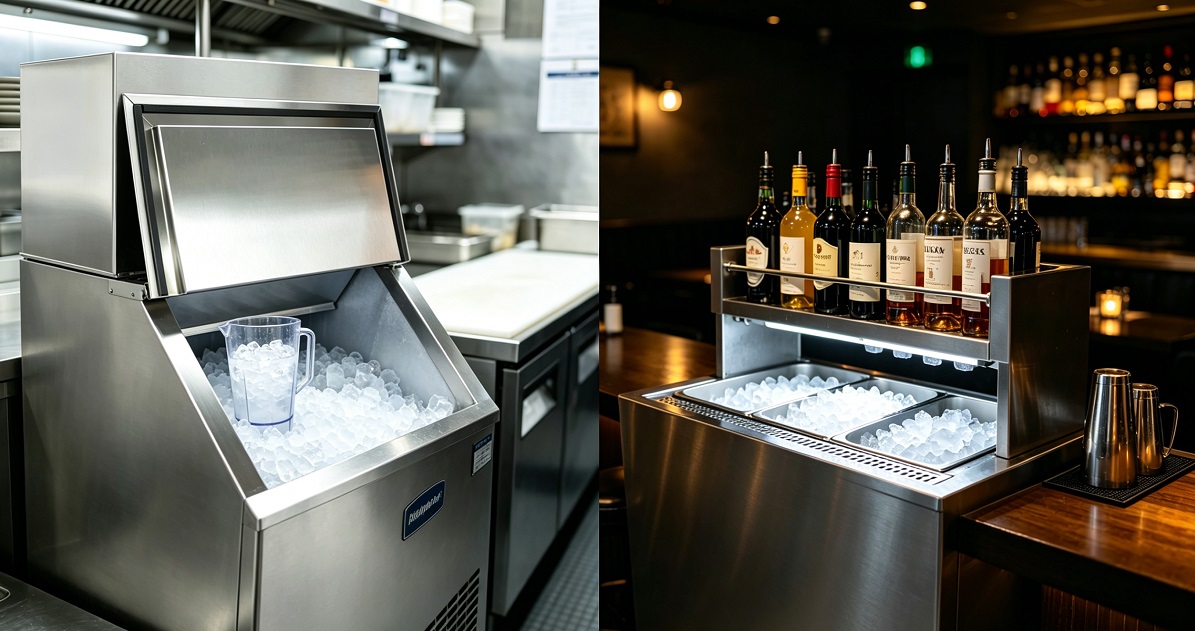
These units are typically placed in the back-of-house (BOH), kitchen prep corridors, or front-of-house server stations next to the soda fountain. Their primary purpose is high-volume utility. Servers or kitchen staff use them to quickly scoop large quantities of ice into water pitchers, soft drink cups, or seafood display trays.
The Bar Ice Bin
These units live exclusively in the underbar lineup, serving as the central "cockpit" of the bartender’s station. A bartender doesn't just scoop ice from it; they build the entire beverage program out of it. It must hold liquors, chill mixers, organize different ice varieties, and interface directly with local plumbing and speed racks.
2. Structural Design and Accessory Integration
Because a bartender balances multiple tasks simultaneously, a bar-specific ice well is highly modular and accessorized, whereas a kitchen ice well emphasizes raw storage capacity.
Accessories Make the Bar Well
A dedicated underbar ice setup is designed to hold multiple add-ons. It features pre-drilled holes to accept front-mounted single or double speed rails for housing house liquors. It often includes internal slots for drop-in dividers, allowing a mixologist to separate standard cubed ice from crushed or pebble ice.
Furthermore, high-end bar models are frequently configured as a specialized drop-in ice bin with cold plate. This mechanical addition features a heavy aluminum plate embedded in the floor of the bin. Soda and mixer lines run through this plate, utilizing the melting ice to chill the liquids before they reach the soda gun, preventing foamy, warm soft drinks during peak hours.
Simplicity Wins in the Kitchen
A restaurant ice bin strips away these front-facing cocktail accessories. Instead, it focuses on attributes like a larger vertical door opening or a heavy-duty lift-up hood. Kitchen units are built to handle rapid, aggressive scooping with extra-wide basins that can easily accommodate oversized 64-oz plastic water pitchers without scraping the sides.
3. Storage Capacities and Depth Profiles
Because kitchen staff and front-of-house servers draw from an ice source intermittently rather than continuously, restaurant-focused units usually feature much larger bulk capacities.
-
Restaurant Storage Needs: A kitchen or server-lane ice storage chest often holds anywhere from 100 lbs to over 400 lbs of ice. They are frequently taller and deeper to act as a massive reservoir for the entire floor staff.
-
Bar Storage Needs: An underbar cocktail well is limited by counter ergonomics. They typically max out between 50 lbs and 110 lbs per bartender station. The focus here is not storing ice for the whole day, but storing just enough to get through a heavy rush shift, with staff replenishing the station from the main back-of-house machine during low-volume lulls.
4. Sanitation and Daily Maintenance Protocols
Both units are heavily regulated by municipal health departments because ice is legally classified as an unpackaged food item. However, the cleaning challenges differ:
-
Restaurant Contamination Risks: In a kitchen environment, ambient grease, airborne flour dust, and food particles are constant threats. Kitchen units require heavy, tightly sealing overlapping lids to protect the ice supply from environmental debris.
-
Bar Contamination Risks: In a bar setting, the primary threat is sticky sugars from spilled syrups, juices, and alcohol bottles placed near the ice. Therefore, an elite underbar unit must be built from premium food-grade 304 stainless steel to resist localized pitting and sugar-acid corrosion. They also require deep-sloped floors to act as a highly effective stainless steel ice bin with drain system, instantly evacuating sugary meltwater.
Summary: Which One Does Your Venue Need?
| Feature | Restaurant Ice Bin | Bar Ice Bin / Well |
| Primary Location | Kitchen / Server Station | Behind the Bar Counter |
| Average Capacity | 100 lbs – 400 lbs+ | 50 lbs – 110 lbs |
| Key Accessories | Wide hoods, high-volume shields | Speed rails, dividers, cold plates |
| Core Metric | Bulk Storage Volume | Bartender Ergonomics & Speed |
If you are setting up a beverage operation, matching the equipment to the correct zone is paramount. To explore how underbar models can optimize your customer-facing service lines, read our ultimate industry deep dive into selecting an elite ice well for your beverage program.